
WMJ publishes special double issue on medical education
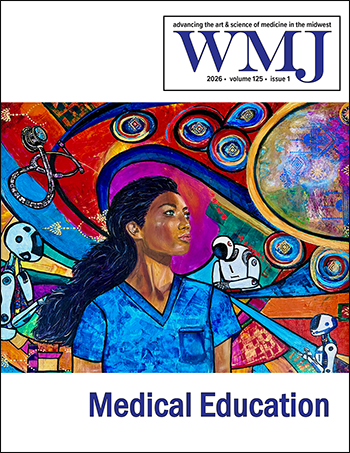
April 3, 2026 – The Wisconsin Medical Journal (WMJ) has published a special double issue devoted to medical education. Featuring original research, editorial content and artwork from more than 200 health professionals, researchers, students and artists, this issue explores topics around four themes: teaching and learning innovations, professional identity and well-being, equity and pathways, and faculty development and lifelong learning.
“Medical education stands at a pivotal crossroads. As our profession redefines competence beyond clinical knowledge – to include empathy, equity, and systems thinking – educators are reimagining how we prepare the next generation of healers,” wrote Fahad Aziz, MD; Leila Famouri, MD, MPH; Bipin Thapa, MD, MS; Tripti Singh, MD; Corlin Jewell, MD; Alisa Hayes, MD; Anna Gaddy, MD; David Rebedew, MD; and Andrew Coyle, MD, in their editorial. “ This issue reflects that transformation through four interconnected themes…each a vital reflection of where medical education stands today and where it must go next.”
The double issue features nearly 50 articles addressing a wide range of topics in medical education, including:
- Novel curricular advances
- Mentorship approaches and outcomes
- Innovations in teaching pedagogy and learning strategies
- New approaches to assessment of skills and knowledge
- Professional and faculty development strategies
- Applications of technology, including artificial intelligence and simulation
- Strategies and programs to advance health equity
- Quality improvement initiatives
- Innovations promoting culturally responsive care
- Interprofessional education and insights
“Across classrooms, simulation centers, rural clinics, and digital learning spaces, educators are redefining what it means to teach, to learn, and ultimately to heal,” the Advisory Board members wrote. “These contributions remind us that medical education is not merely about transmitting knowledge; it is about shaping character, cultivating empathy, and nurturing the resilience required to serve patients and communities.”
This special issue was shaped by the expertise and guidance of a 19-member advisory board (below) composed of faculty leaders in medical education from the Medical College of Wisconsin, the University of Wisconsin School of Medicine and Public Health, and the Mayo Clinic College of Medicine and Science.
WMJ is a peer-reviewed, indexed journal owned jointly by the Medical College of Wisconsin and the University of Wisconsin School of Medicine and Public Health.
Special Issue Advisory Board
Fahad Aziz, MD, MBA, CPE, FASN, WMJ Editor-in-Chief
Flesch Family Faculty Fellow
Associate Professor of Medicine (CHS)
Division Head, Nephrology
Program Director Nephrology Fellowship Program
Division of Nephrology, Department of Medicine
University of Wisconsin (UW) School of Medicine and Public Health
Andrew D. Calvin, MD, MPH
Consultant, Department of Cardiovascular Medicine
Chair of Education, Mayo Clinic Health System
Associate Dean – Accreditation and Compliance, Mayo Clinic School of
Continuous Professional Development
Associate Professor of Medicine, Mayo Clinic College of Medicine and Science
Trevor Cooper, MD, MPH, MPP
Preventive Medicine Chief Resident Physician, PGY-3
UW School of Medicine and Public Health
Andrew Coyle, MD
Program Director, Internal Medicine Residency Program
Associate Professor (CHS), Department of Medicine
UW School of Medicine and Public Health
M. Leila Famouri, MD, MPH
Assistant Professor (CHS), Division of General Internal Medicine
Department of Medicine
Director, Health Equity Pathway
Internal Medicine Residency Program
UW School of Medicine and Public Health
Anna Gaddy, MD, FASN, FNKF
Associate Professor, Nephrology
Internal Medicine Clerkship Director
Medical College of Wisconsin
Alisa Hayes, MD, MSAM
Associate Professor
Department of Emergency Medicine
Vice Chair of Education & Training
Director of Undergraduate Medical Education
Medical College of Wisconsin
Mike Houghan, MD
Assistant Professor (CHS), Department of Medicine
UW School of Medicine and Public Health
Corlin Jewell, MD
Director, Medical Student Education
Undergraduate Medical Education
Fellowship Director
Partner Longitudinal Teaching Coach (SMPH)
Assistant Professor (CHS)
BerbeeWalsh Department of Emergency Medicine
UW School of Medicine and Public Health
Tess Jewell, MD, MPH
PL1 Resident, Physician-Scientist Training Pathway
Department of Pediatrics
UW School of Medicine and Public Health
Bryan Johnston, MD
Family & Addiction Medicine Physician
Associate Professor of Family & Community Medicine
Family Medicine Clerkship Director
Core Faculty, North Side FM Residency Program
Medical College of Wisconsin
Jahanvi Patel Kothari, DO, FAAFP
Assistant Professor, Medical College of Wisconsin
Director of Medical Student Education – Department of Family and Community Medicine
Medical Director, Assistant Program Director – Froedtert & MCW South Side Family Medicine Residency
David Rebedew, MD, FAAFP, DABOM, CMD
Clinical Adjunct
UW School of Medicine and Public Health
Patrick Remington, MD, MPH, FACPM
Professor Emeritus, Preventive Medicine Residency Program, Department of Population Health Sciences
UW School of Medicine and Public Health
Jean Marie Riquelme, MD, FAAFP
Clinical Professor, Department of Family Medicine and Community Health
UW School of Medicine and Public Health
Christie Seibert, MD, MACP
Associate Dean for Medical Student Education and Services
Professor of Medicine
UW School of Medicine and Public Health
Bipin Thapa, MD, MS, FACP
Professor of Medicine, Department of Medicine
MCWFusion Curriculum Phase 2 Director
Assistant Dean for Clinical Science
Curriculum, School of Medicine
Medical College of Wisconsin
Tripti Singh, MD
Associate Professor of Medicine (CHS)
Medical Director, Acute Inpatient Dialysis Unit, Lupus Nephritis Clinic, UW Health
UW School of Medicine and Public Health
Amy Zelenski, PhD
Associate Professor, General Internal Medicine
UW School of Medicine and Public Health